%20copy.png)


Your Guide To The Diriyah Contemporary Art Biennale 2026

The Diriyah Contemporary Art Biennale 2026 is not an exhibition but a cultural statement for Saudi Arabia

Diriyah does not lack symbolism. It carries the weight of origin stories, of architecture preserved and retold. What is new is how confidently it now hosts the contemporary.
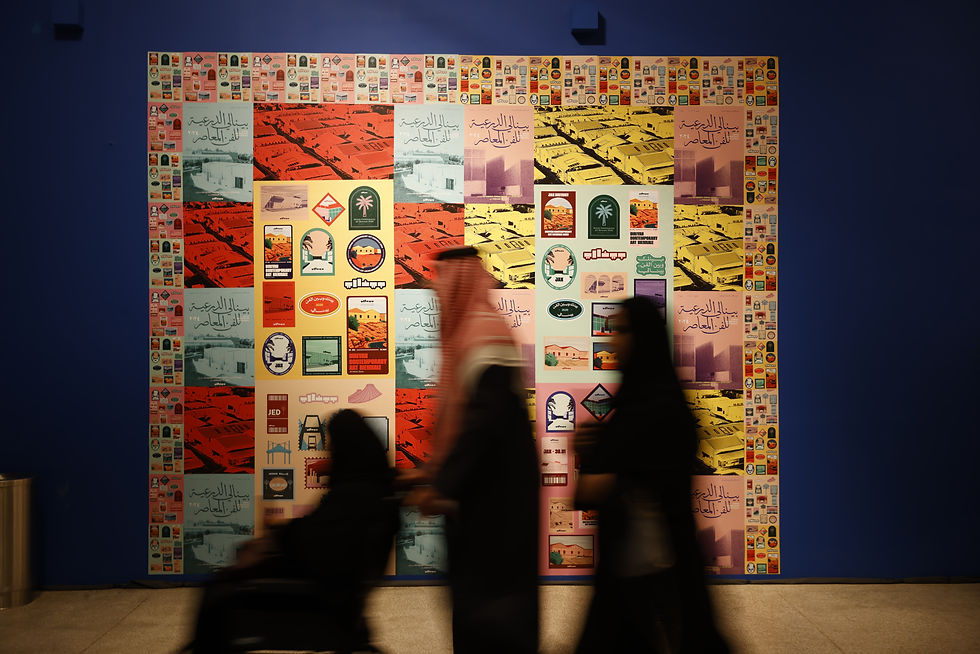
The third Diriyah Contemporary Art Biennale opened on 30 January 2026 and runs through 2 May 2026. Titled “في الحِلّ والترحال” / In Interludes and Transitions”, it unfolds across JAX District, the industrial quarter turned cultural hub, minutes from At-Turaif.
This edition is led by Co-Artistic Directors Nora Razian and Sabih Ahmed. Their framework is deliberate. The Biennale considers the world as procession, as movement shaped by trade, exile, wind, song, and migration. The title borrows from a phrase associated with cycles of encampment and journey in the Arabian Peninsula. It is a reference that feels geographically specific, not decorative.
The scale
The 2026 edition presents the work of 68 artists from more than 37 nations, with over 25 new commissions. The number matters less than the breadth. Established names sit beside emerging voices. Saudi artists are not positioned as a footnote. They are central.
The exhibition occupies 12,900 square meters of halls, courtyards, and terraces. The scenography, conceived by Formafantasma, reworks the industrial shell of JAX into a sequence of curved passages and planes that guide visitors through a continuous flow. It is measured rather than theatrical. The architecture does not compete with the work. It frames it.

What defines this edition
Sound is a quiet protagonist.
The curatorial premise foregrounds musicality and oral transmission as vehicles of memory across the Arab region and beyond. This emphasis is most visibly embodied in Folding the Tents (2026) by Saudi artist Mohammed Alhamdan, known as 7amdan. The commissioned procession moves through Wadi Hanifah and into JAX, concluding with a performance by Miniawy Trio. The gesture is simple. A procession. Yet within it sits a broader proposition about continuity between ancient gathering and contemporary practice.
“In Interludes and Transitions” resists the idea of fixed origin. It speaks instead of overlapping routes and relations. The argument is not delivered loudly. It is built across rooms.
Why it matters now
The Diriyah Biennale Foundation was established to stage recurring world-class biennales and to cultivate sustained engagement with contemporary and Islamic art. In five years, it has already delivered five biennales. That continuity is significant.
Aya Al-Bakree, CEO of the Foundation, describes the current edition as documenting a breadth of artistic practices while platforming artists and investing in community. The statement is pragmatic. The ambition is visible.
For Saudi Arabia, the Biennale is not simply a cultural event. It is infrastructure. It creates expectation. It positions Diriyah as a site where international discourse takes place, not somewhere it passes through.
The essentials
Dates: 30 January 2026 to 2 May 2026
Location: Diriyah, at JAX District
Tickets: General admission is free, but you still need to book a timed ticket through the Biennale site. If you want a deeper read of the works and the curatorial through line, there are guided group tours (listed as paid)
Opening hours
Regular hours, Saturday to Friday
Galleries: 3:00pm to 11:00pmVenue: 3:00pm to 12:00am
The “venue” hours matter if you are planning to linger, meet friends, or build your visit around the Biennale’s wider rhythm.
Ramadan hours
Galleries: 8:00pm to 1:00amVenue: 8:00pm to 2:00am
This shift changes the entire texture of the visit. You are not doing an afternoon wander, you are arriving into night, into conversation, into the city’s Ramadan pace.
Getting there, parking, arrival
If you are driving, the Biennale lists the address as King Faisal Road, Ad Diriyah, Riyadh 13711, and notes complimentary public parking nearby, plus valet for a fee.
Plan to arrive with a little buffer. JAX District is an active cultural zone, and on busy nights the flow in and out can be part of the experience.
How to experience it, without doing too much
The most rewarding way to approach the Biennale is to treat it like a city, not a checklist.
Start with one gallery, not the whole map
Give yourself permission to spend real time with fewer works. Contemporary art does not reward speed. It rewards attention, and mood, and the willingness to sit with something before you decide what it is.
Build a rhythm
A strong first visit is often:
one focused loop through the main galleries
a pause, a reset, a drink, a second wind
then a return for one or two sections you want to see again
That second pass is where meaning tends to settle.
Go once for impact, go again for understanding
The Biennale’s scale is designed for return visits. Your first night is for visual memory. Your second is for pattern recognition, what is being asked, what is being echoed, what feels distinctly of this moment.
A simple first timer itinerary
If you have 90 minutes
Do one full gallery loop, pick five works to stay with, end with a slow walk through the space to absorb the atmosphere.
If you have 2.5 to 3 hours
Do two gallery loops with a break in between, the second loop is for revisiting what stayed in your mind.
If you are visiting in Ramadan
Arrive after 9:00pm, keep the pace unhurried, and let it be an evening, not an assignment. The later venue hours make it easy to stay without rushing.