%20copy.png)


Van Cleef & Arpels Writes a High Jewelry Saga

The Maison builds a maritime narrative through technical mastery
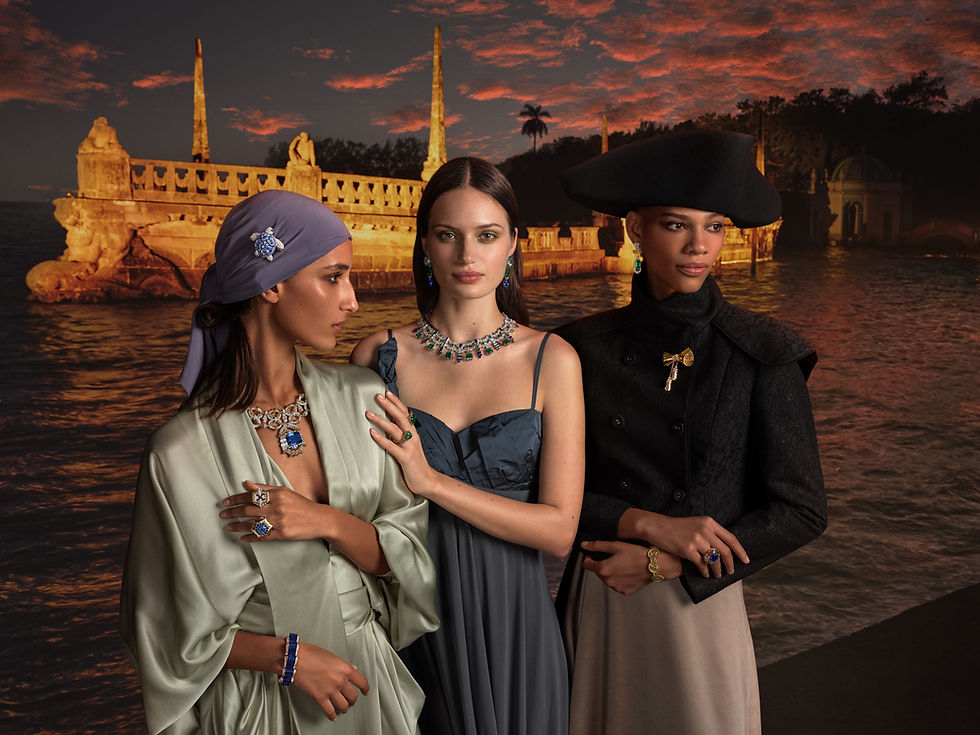
Van Cleef & Arpels returns to literature as structural inspiration with Treasure Island, its latest High Jewelry collection drawn from Robert Louis Stevenson’s 1883 novel.
The Maison has long engaged with narrative works, from Shakespeare to Jules Verne. This collection extends that lineage, translating Stevenson’s maritime world into a three-part jewelry saga shaped by sea, island, and treasure. The approach is architectural rather than illustrative. Each chapter builds technically and materially on the last.
Heritage as Framework
Van Cleef & Arpels does not approach maritime imagery as novelty. The Maison’s archives document a sustained engagement with nautical themes: early twentieth-century yacht models in gold and enamel, marine clips, and shell-inspired creations. The scale model of the Varuna, created in 1906, already established this language within the house vocabulary.
Treasure Island revisits that territory through contemporary technique.
From the outset, stone selection anchors the collection. Clarity, saturation, proportion, and surface character govern the curation. The palette moves deliberately across turquoise blues, saturated emerald greens, velvety rubies, and lavender jadeite. The result is chromatic architecture rather than decorative abundance.
Chapter I: The Sea
The first chapter interprets navigation, rope work, and open water.
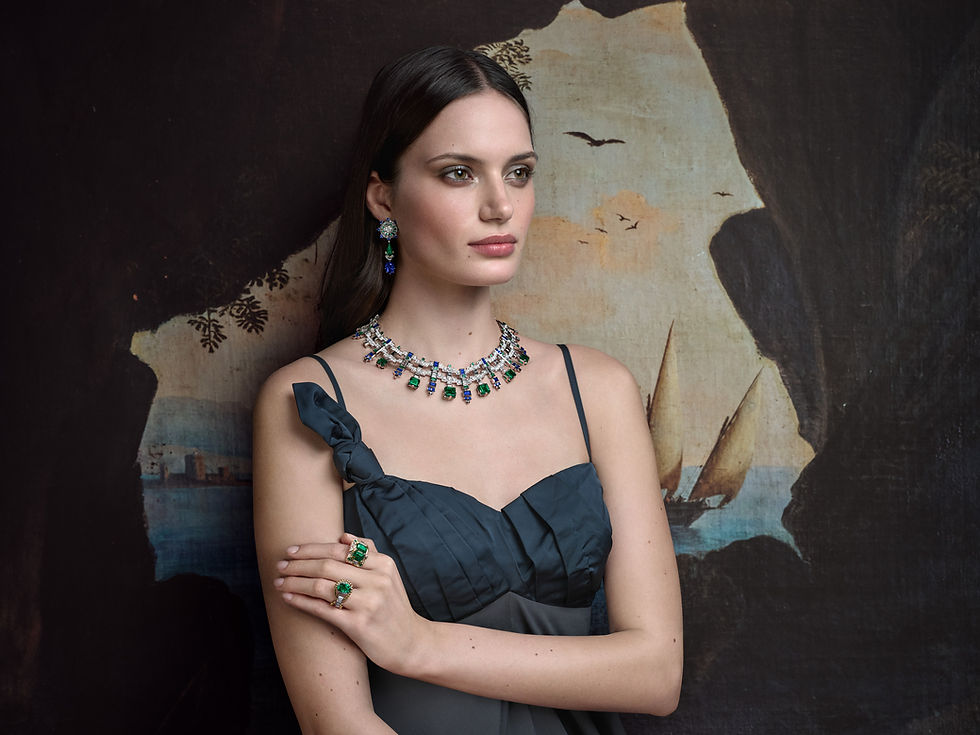
The Écume Mystérieuse necklace builds wave movement through alternating structures of diamonds and sapphires set using the Traditional Mystery Set technique. Patented in 1933, this method conceals the underlying metal, allowing uninterrupted fields of color. Here, sapphires form deep marine bands punctuated by diamond crests that evoke foam without literal depiction.
The Cordage infini transformable necklace references sailor’s knots through intertwined rows of diamonds and baguette sapphires. Two pear-shaped sapphires, weighing a combined 35.37 carats, suspend from tasselled terminals and detach to form earrings. Months of lapidary coordination ensured mirror symmetry between the stones.
En haute mer continues the maritime study through braided gold construction. A 55.34-carat emerald-cut sapphire anchors the piece horizontally, echoing deck line geometry. The central stone detaches to become a solitaire ring, reinforcing the Maison’s longstanding commitment to transformability.
The Onde Mystérieuse box extends the chapter into precious object territory. Crafted in hammered white gold with paillonné enamel and blue quartz, it conceals a diamond-set dial beneath interchangeable clips. Watchmaking, goldsmithing, and gem-setting converge in a single piece.
Chapter II: The Island
The second movement shifts from horizon to land.

The Palmeraie merveilleuse necklace articulates palm leaves through convex and concave volumes. At its center, a 47.93-carat emerald cabochon anchors the composition. The articulation required significant structural precision to maintain fluidity across the neckline.
Coquillage Mystérieux forms a sculptural shell in buff-topped rubies set via Mystery Set. Its reverse reveals a fairy holding an emerald, an emblematic figure within the Maison’s iconography. Technical discipline extends to the back, where finishing mirrors the front.
The Coquilles Mystérieuses bracelet references Rococo curvature. Articulation ensures flexibility across the wrist, while scalloped white gold edges reinforce surface continuity. The Tortue de Cocos bleue clip presents luminous blue sapphires arranged in mosaic across a domed shell. Openwork beneath enhances light penetration.
Throughout this chapter, flora and fauna are interpreted through volume and surface technique rather than literal storytelling. Gold is hammered, engraved, beaded, and polished to create depth across small-scale forms.
Chapter III: The Treasure
The final chapter explores cross-cultural references.

The Carte au trésor clip folds engraved gold into a scroll sealed with rose gold cord. Between its layers, a map engraved with imagined topographies is revealed, marked by a ruby indicating the treasure’s location. Ornement d’Alexandrina crowns a 12.69-carat violet sapphire within a domed structure layered with emeralds, rubies, and garnets. Mughal symmetry informs the Splendeur indienne ring trio, where floral geometry and multilevel construction demand complex polishing across miniature surfaces.
Lanternes Mystérieuses unfolds 31 lavender jadeite beads totaling 930.21 carats into a transformable long necklace. Buff-topped rubies set via Mystery Set conceal clasps and enable modular wear. Libertad earrings, inspired by pre-Columbian goldwork, suspend matched pear- and oval-cut diamonds in articulated structures engineered for balance.
Across these pieces, setting techniques shift between grain, prong, closed bezel, and rail. Metalwork alternates between hammering, gadrooning, engraving, and mirror polish. The collection demonstrates technical continuity across eras while expanding chromatic intensity.
A Narrative Discipline
Treasure Island operates as a constructed journey rather than a thematic collage. Each chapter escalates in material complexity and geographic reference.

The Maison reinforces its signature techniques, Traditional Mystery Set, transformability, articulated structures, while integrating rare gemstones at scale. Emerald cabochons exceeding 40 carats, jadeite beads nearing 1,000 carats collectively, and sapphires surpassing 55 carats position the collection within the highest tier of High Jewelry production.
Literature provides narrative structure. Craft provides authority.
In translating Stevenson’s adventure into gold and stone, Van Cleef & Arpels advances a house language that is archival, technical, and resolutely contemporary.


